Wednesday, March 2, 2011

National Aeronautics


NASA
The National Aeronautics and Space Administration (NASA, pronounced /ˈn誑ə/) is an agency of the United States government, responsible for the nation's public space program. NASA was established by the National Aeronautics and Space Act on July 29, 1958, replacing its predecessor, the National Advisory Committee for Aeronautics (NACA). The agency became operational on October 1, 1958.[3][4] NASA has led U.S. efforts for space exploration ever since, resulting in the Apollo missions to the Moon, the Skylab space station, and later the Space Shuttle. Currently NASA is supporting the International Space Station and developing new Ares I and V launch vehicles.
In addition to the space program, it is also responsible for long-term civilian and military aerospace research. NASA Science is focused on better understanding Earth itself through the Earth Observing System,[5] advancing heliophysics through the efforts of the Science Mission Directorate's Heliophysics Research

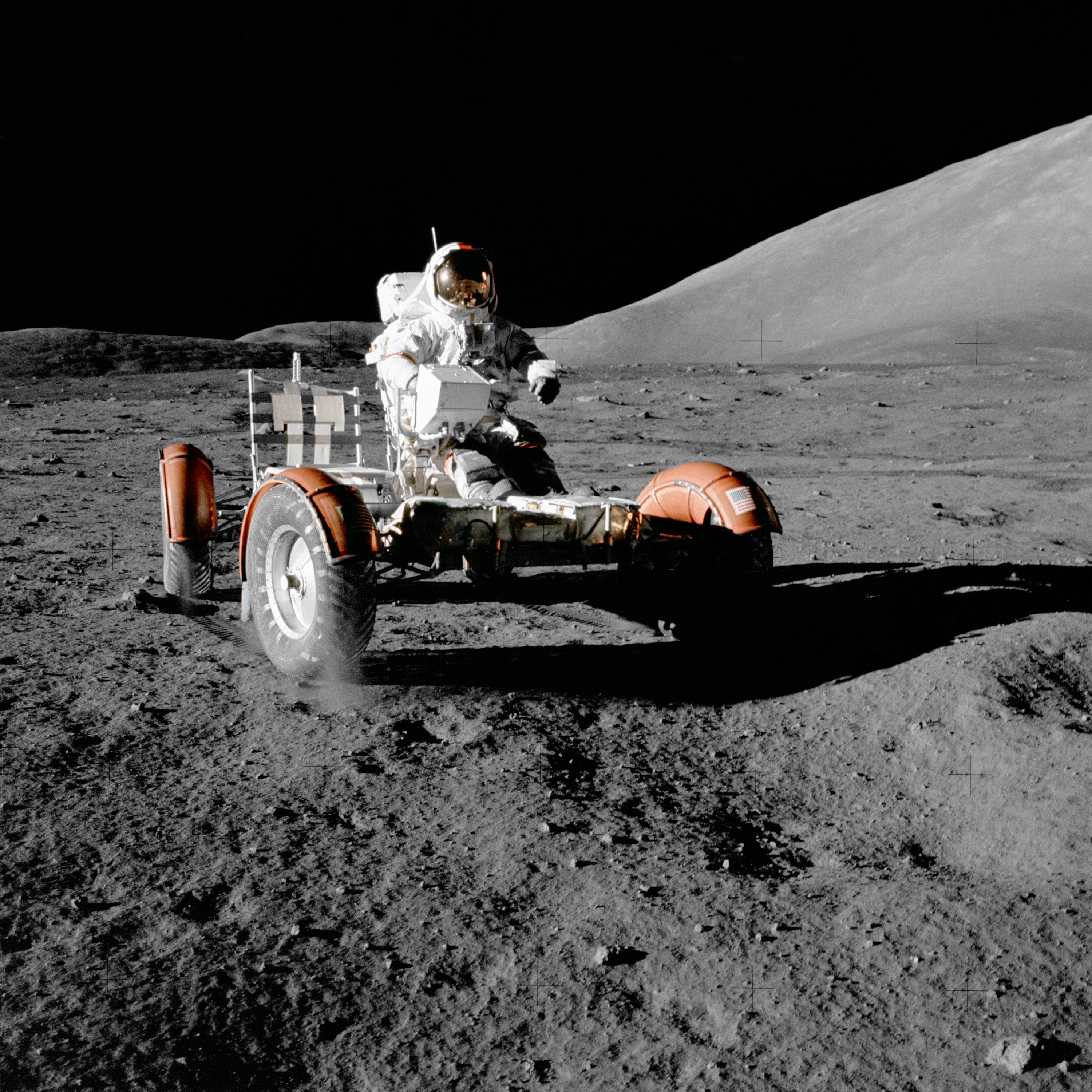
NASA Apollo 17 Lunar Roving

Astronomy Picture of the Day

See Explanation.  Clicking on the picture will download 
 the highest resolution version available.

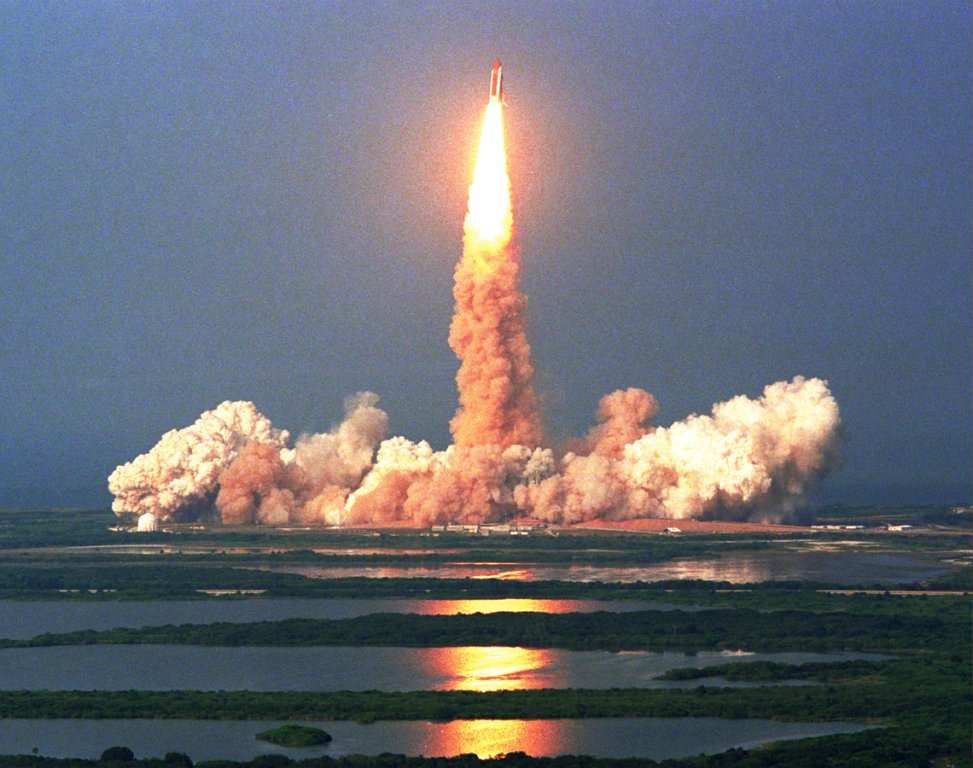
Explanation: Happy Birthday, NASA! The National Aeronautics and Space Administration officially began operations on October 1, 1958, absorbing its forerunner organization the National Advisory Committee for Aeronautics, NACA. Its landmark achievements in human spaceflight include the Mercury and Gemini Projects culminating in the Apollo Project moon landings in the 1960s and early 1970s, Apollo-Soyuz and Skylab in the 1970s, and the Space Shuttle program of the 1980s and 1990s. (Pictured is the June 1998 launch of the Space Shuttle Discovery.) NASA's science programs have produced the robotic exploration of our Solar System, views of the Universe across the electromagnetic spectrum, and valuable meteorological and remote-sensing Earth observations. At birth, NASA's priorities were largely driven by the pressures and competitions of the Cold War. But looking back over 40 years, the sum of its accomplishments have produced needed new technologies and a vital new perspective on Planet Earth and the Cosmos.

Slide Show: Students Gear Up for NASA's Annual Moon Buggy Race

NASA,lunar,student THE ORIGINAL (CIRCA 1971): The Great Moonbuggy Race at NASA's Marshall Space Flight Center challenges high school and college students to engineer a rover under some of the same restrictions the space agency faced when building the original in the 1960s. Moon buggy rovers must first fit into a cube with four-foot (1.2-meter) sides, roughly the same dimensions in which the original lunar rover needed to fit for travel to the moon.

This image of Comet Hale-Bopp is courtesy of Fred Espenak, NASA GSFC.

Comet Hale-Bopp

The solar wind varies routinely through the 27-day rotation of the Sun, as well as sporadically, in response to violent eruptions in the corona. These eruptions can result in geomagnetic storms on Earth. Read more about space weather... The composition of the solar wind reflects the composition of the solar corona, modified by solar wind processes. The exact mechanism of solar wind formation is not known. Accurately measuring its composition aids in separating the effects of these processes from the original makeup of the corona.

For NASA no easy answer for next space destination


WASHINGTON (AP) -– Where to next? It's a simple question that NASA can't answer so easily anymore. The veteran space shuttle fleet is months from being mothballed and the White House has nixed a previous plan to fly to the moon.
For the first time in decades, NASA has no specific space destination for its next stop, although it has lots of places it wants to go. Future space flight, NASA officials say, now depends on new rocket science and where it can take us.

That uncertainty may not sit well with Congress, which will be grilling NASA chief Charles Bolden on Wednesday and Thursday in the first hearings since the George W. Bush moon mission was shelved.

There are only a few places in space where humans can go in the next couple of decades. NASA wants to go to all of them, with the ultimate destination, as always, being Mars.

“The suite of destinations has not changed over time,” NASA deputy administrator Lori Garver said in an interview. “The moon, asteroids, Mars — if you're going to go anywhere — is where we are going.” But with any itinerary there is a first stop. So what is that?

Check back in a couple of years. That's when new technology should be developed enough to answer that question, Garver said. President Barack Obama plans to divert billions of dollars from the Bush moon plan toward developing better rocketry. “The best way to get anywhere … is really invest in technologies that will reduce the cost, reduce the time, reduce the risk and so forth,” Garver said.

Some of those technologies seem like science fiction. The possibilities noted by experts inside and outside of NASA include the equivalent of an in-orbit gas station, electric-hybrid rockets, nuclear thermal rockets, inflatable parts for spaceships, and methods of beaming power between Earth and space.

Art and the Promotion of Space Exploration

NASA Lunar Basex
NASA Lunar Base
A 1949 Gallup poll of Americans found that only 15% of the public believed that man would walk on the Moon by 2000. How is it that we accomplished this by 1969? Of course the Cold War and a series of Soviet space firsts played the lead role. But space art also played a role in providing for the population a visualization of what space exploration could be like.
Space art still has a role to play in exposing the public to the vision of what it would mean to truly become a spacefaring civilization. There is a precedent for art’s ability to shape public policy. One of my favorite artists is Thomas Moran, an outstanding painter of the Hudson River School. One of Moran’s landscape subjects was Yellowstone, which he visited as part of an expedition in 1871. His paintings of the landscape had such an impact on the public that in 1872 Yellowstone was made our nation’s first national park. If you would like to know more about Thomas Moran and his art, I recommend the book Thomas Moran.
Peter A. Nisbet, a well known landscape artist who was part of the NASA Art Program, said that “Art is about what words cannot express. Many things have happened in the exploration of space that people cannot know through photographs or newspapers/television reporting. It is the artist’s task to bring forth the mysterious, the exalted, the great beauty and power surrounding these events.”